Showing posts with label review. Show all posts

Wednesday, January 22, 2025

Recently Read: Skylark Three by E. E. Smith


Years ago I reread and reviewed The Skylark of Space by E. E. Smith (1890-1965), a seminal work of science fiction for one salient fact—it was the first ever depiction of a starship. It was written well over a hundred years ago and first published in 1928, serialised by editor Hugo Gernsbach in Amazing Stories, and it must have been an immediate hit because the second novel appeared, also in Amazing, from August, 1930.

I have the Panther/Granada paperback editions from the early-mid 1970s—the very same copies I bought when I was a preteen. The Chris Foss covers were major selling points, paintings that just jumped off the shelf at the browser and said ‘buy me!’ That was the glory days of Foss’s productivity: he could churn out three covers a week, so much in demand was his work—it characterised his generation, in a sense. His paintings certainly spoke to the young me with a sense of not just futurism but of the most up to date sort, a compelling vision that lent credence to the work between the covers (not that his paintings ever really depicted what was going on in the book).

The cover of Skylark Three shows a great space vessel in the act of blowing up as three very different craft race by, implicitly an act of battle. Fair enough, there are space battles in the book, and with the visual hook dispensed with, as well as the nostalgia, what’s under the covers?

A most interesting sojourn, to say the least, made curious and oh, so much a period piece, for the simple fact this novel was written 95 years ago. It reflects then-current American society—strong moral values, a willingness to get tough when the need arises (as it frequently does), women who fetch food and black people don’t seem to exist. What else would it depict? It moves on from the stereotypes in the first novel in a way, because the woman accompany their husbands as functional members of the ship’s compliment, taking part in its operation (as well as fetching food). To be fair, Seaton’s wife is show to be a brilliant classical musician, taking he violin with them into the depths of space, a surprising artistic interlude amongst the unremitting technicality of the piece.

Smith, considered the founding father of the “space opera” subgenre, wrote almost compulsively in the vernacular of his times, and sometimes the reader puzzles over the slang of 1930. The characters talk so quaintly to our ears, and not the formal, over-verbose 19th century way so familiar from the writers of the previous generations, but in a strange admixture of both precision and slang that must have been how the mass market expressed itself in those days. It underlines the way H P Lovecraft thought (they were born in the same year), for he was writing at the same time and his characters and narrative sound precisely nothing like this, even when he is dealing with his contemporary United States.

In Skylark Three, Smith takes is heroes Seaton and Crane and their wives, Dorothy and Margaret, back into the depths of space, to the system of the multiple green suns near the heart of the galaxy, into the midst of war and terror. A new power has emerged, destroying wherever it touches—the Fenacrhone, travelling from far across the galaxy bent on universal conquest. It is up to Seaton (the acknowledged ‘Overlord’ of the planetary systems since his last visit—yes, a white American is the unquestioned ruler of multiple civilisations!) to convince the many races of the cluster of the green suns to work together to resist this scourge, and he recruits the best science and industrial capacity of each to this end. He ends a war between old adversaries, visits multiple planets with strange civilisations (Smith had a lot of fun creating them), and orders the construction of a new vessel to replace his now clearly obsolete Skylark II.

Smith was a scientist, a chemist by training like Isaac Asimov, and it is clear that his mind ran on through tracts of technical thought, addressing concepts that would become familiar much later in time. Star Trek, 35 years later, drew on concepts well known to Smith’s readers—the tractor beam, for instance, directed energy weapons, force fields, and of course faster than light travel. The manipulation of matter, its interchange with energy, is also depicted, though in different terminology, as we see “force” beams and “orders of force” levitating objects, assembling them from raw materials and so forth.

A prime tool is the “educator,” a machine of alien derivation, which allows the transfer of knowledge, experience and empirical data between minds (shades of the “BIG RAT”in Gerry Anderson’s 1968 series Joe-90, which formed the central gadget of a whole show). The characters use the device to absorb instantly the language of any alien race they encounter, and to provide knowledge of English to other races, as well as acquire the technical and scientific knowledge of the finest minds out there, thus improving their own ship over and over. This neatly avoids the elephant in the room of so much TV science fiction—why almost all the alien races and isolated cultures we ever encounter not only look fundamentally the same as ourselves but speak fluent English, most of them with American accents...

The speed of light is mentioned, though no relatavistic effects or consequences. Perhaps, when the publisher gave Smith a free hand to update his narratives for their re-release in later decades, he found incorporating Einsteinian cosmology either prohibitively difficult, or that it simply forbade the possibility of his narrative, and he sidestepped the issue by ignoring it. Indeed, Smith acknowledged his Skylark novels to be science fantasy, in contrast to his 1930-31 novel Spacehounds of IPC, (completed immediately after Skylark Three) which takes place entirely within the solar system and was, he felt, his only work of genuine science fiction. (Readers did not respond so well to it for this very restriction, however, and no sequels followed.)

Interestingly, amongst all these concepts, the word computer never appears, though he describes automated systems which to us seem obviously computerised.

The thing that jumps off the page, however (after his often erratic narrative to dialogue balance—early chapters seem almost entirely composed of the latter) is attitude. Seaton, the polymath, though not the most brilliant mind on the ship, is a self-appointed master of worlds, willing to scheme the destruction of a whole civilisation to save others—redeemed by his humanistic inability to do so at the last moment: that task he left to a friend from a warrior race who had no compunction about pushing the button. Would we call that a cop-out today? Smith certainly revelled in the absolute destruction of a malevolent foe: every last ship in space, one by one, then incinerating their homeworld. Finally, when the eponymous Skylark Three actually takes flight, he details a racing voyage out of the galaxy on the trail of a vessel bearing survivors of the evil Fenachrone to a new world in a distant galaxy to begin again, bent on returning one day to annihilate all competition in the home galaxy. The outcome is of course their inevitable destruction. This, we would call today, genocide—and it was done by the hero.

That’s the difference a century makes, but consider the time in which he was writing. This is the same general era in which Edgar Rice Burroughs wrote his Venus novels, and I think I see a parallel, inasmuch as that both writers were observing the insidious rise of fascism. The Nazi Party in Germany was parading and trumpeting and throwing its weight about, eventually taking power in 1933, and writers were using fiction as a way of saying something about it. Burroughs highlighted the armies and secret police forces, the evils redolent in such rogue states, while Smith, just a few years earlier, described technology coming to the rescue, stopping very dead indeed an entity bent on doing what Hitler did, but on a galactic, even universal scale. In that light, perhaps the nature of the story is understandable, reassuring its readers that the will to defend against an implacable enemy really did exist.

One last bit of nostalgia begs to be mentioned. When I reached Chapter 3, there was a bookmark in the volume, just a business card, for an engine rebuilders. The phone number has too few digits, not even the eighth digit added to all Australian phone numbers in 1976 or so. That bookmark must indicate where I got up to when I read the book as a preteen, before finding it too heavy going and moving on to something else. I doubt that business has existed in a great many years. I put the card back where I found it, and there it shall remain, another piece of history that is now much older than the novel was when I bought this edition. Passage of time, eh?


Mike Adamson


Saturday, January 6, 2024

Eight Years and Counting

I remember like it was yesterday—the first confident submission of this campaign to get my foot in the door of the short story market. I sent a Roman era ghost story to a magazine called Liminal. I was full of hope, but of course inexperienced—green, if you like—and had no real idea what to expect. I’d made a few experimental submissions in the previous months but wasn’t counting those. Well, Liminal didn’t take the story, nor did they ever take anything from me, and ceased publication a couple of years ago. But that ghost story placed four days ago with Black Beacon Books, in a freshly-polished form, so my original confidence was vindicated at last!

At the eight year mark I’d have to say I’ve raised my game. I’ve tuned what I’m doing to better match the market, certainly I’m focusing on those parts that are most welcoming: perhaps a third of my expected placements in the coming year will be period mystery, or speculative fiction in a certain group of markets where I’ve encountered my best success. That still leaves two thirds on the submit-and-see principal, so nothing has changed in that respect.

However, I am beginning to move into novels and single-author anthologies, and this is the main step-up, or direction change, in my modus operandi.

This is my eighth annual review of progress/state of play post, and 2023 has laid the foundations for ambitious steps to come.

Here's the raw data:

In the last eight years, I’ve made 3119 submissions (270 in the last year, a lot less than the previous year). I have 244 placements (12.78:1 submission/acceptance ratio, up from 14.53:1 last year, which was up from 15.11:1 the year before that, which bettered 16.008:1 in the previous year). It’s gratifying to see this consistent positive decrease over the last four years, as my rate of placement is improving across the board despite all influences of market, economics, style or whatever).

However, my total number of submissions in play has eroded considerably, as my attention has been focused less on short story writing and more on long-form work. Submission Grinder shows some 32 submissions in play at this time, of which a few early ones are likely dead or in limbo, and this figure is less than half my tally for this time last year. These figures also indicate 2843 rejections, giving an overall rejection/acceptance ratio since 2016 of 11.65:1—again, an improvement for the fourth year running (2022: 13.178:1; 2021: 13.52:1; 2020: 14.27:1). The statistician in me sees these numbers and despite any negative feedback on individual works from individual markets—I certainly get it—I know I must be doing something right.

In the 365 days of 2023, I made 275 submissions (well down on the 368 of last year), of which 38 gained acceptances (my second-best year ever after 2021 with 41). This is a submission/rejection ratio for the year of just 7.23:1, a dramatic increase over last year’s 11.5:1, which improved from 2021's 12.375:1, and, most importantly, also edges out 2020's 7.67:1. While it may not have felt like it on a day to day basis, I seem to be doing better than at any previous time.

Average time between acceptances in Year Eight was comfortably down from 2022’s 11.4 days to just 9.60 days—not quite as good as 2021’s 9.125 days: it seems hard times are still with the reading and publishing world. The long dead patches still occur, and with fewer submissions in play I’ve noticed that the previous pattern of long and short period rejections don’t cluster as they used to—I simply go more periods with neither acceptances nor rejections, just...nothing.

One or two semi-professional, placements have come along—with NewMyths, for instance, always a pleasure.

Rather shockingly, I find my new fiction productivity has been at its lowest ebb since the process began, just 16 new stories completed in 2023, half of which are Sherlock Holmes tales. They total 131, 793 words, down from last year’s 175, 871. This is balanced perhaps by my reworking of older pieces to find homes.

I have 300 stories registered at Submission Grinder, a modest increase over last year’s total, though excluding different versions of the same story which in a few cases are listed there for my own reference.

Once again, Sherlock Holmes is my hottest area of endeavour. I have an estimated eight stories to produce in 2024, all of which have target marketplaces and excellent chances of acceptance. I now have eleven placements with Belanger Books anthologies, and have found a home also with MX Books’ ongoing Anthology of New Sherlock Holmes Stories series. I have placed a third story with Strand Magazine, and an confident of others in future.

My novel Sherlock Holmes: A Tradition of Evil, was released by Belanger Books in August, 2023, and marks the beginning of a new chapter in this endeavour. It has been well received so far, with predominantly five star reactions at both Amazon and Goodreads, and I should be writing my second novel during 2024. My Sherlock Holmes short story output for 2023 was 78, 083 words, slightly up on last year, and excluding a single story as yet unfinished.

I also have three single-author anthologies in development: a collection of my vampire tales forthcoming from Hiraeth Books in the US, which is now at an advanced stage of readiness, plus Holmesian and Lovecraftian volumes also on the table for this year. Also, a chapbook is due out soon from Black Hare here in Australia, a psychological thriller titled If Thine Eye Offend Thee. This will be in format with my previous release with them, The Salamandrion.

My total accepted word count stands at 1, 248, 985 words—this including all reprints and solicitations, as well as podcasts—there have been a few (links on my author site).

The Inspector Trevelyan Mysteries has scored an extra placement, a tale appearing shortly in Black Cat Weekly. A George Trevelyan novel is now very much on the cards, probably for 2025, which on the back of an expanding small press track record may be a flag-carrier for the next level of this enterprise.

That's the view from this particular keyboard as Year Eight melds into Nine. Short fiction is beginning to give way to long form work, and my small press credits are expanding (both novels and collections based in large part on preexisting work, though always with some new material for freshness). I hope a year from now I have more big steps to report!


Cheers, Mike Adamson

Royalty-free image from Unsplash.

Friday, November 3, 2023

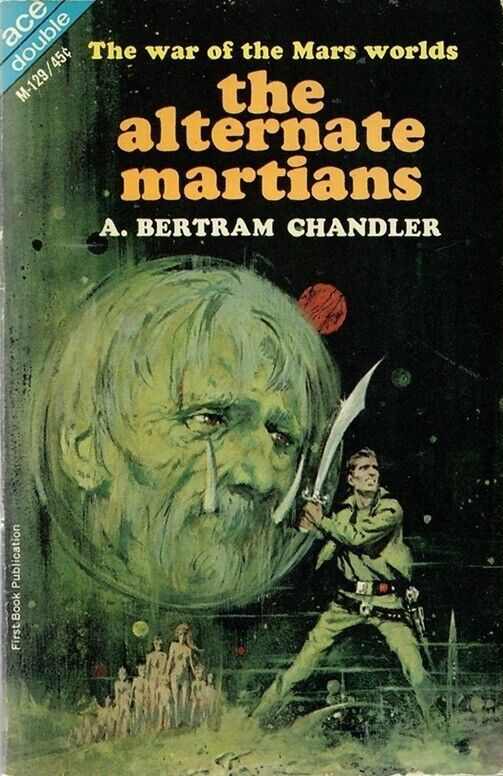
Recently Read: The Alternate Martians by A. Bertram Chandler


Here is a novel I first read as a child of ten years or so, and indeed it was the same copy. We have a 1965 Ace first edition, in poor condition (this will probably be the last time it's ever subjected to a reading, and there are better copies out there to be had). I last read it probably some decades ago, and had only a few memories to draw on, but this was the sequel to Chandler's The Coils of Time, which I reviewed in February, 2017, so it was a logical choice.

Chandler (1912-1984) was one of our favourite science fiction writers in the far-off days of childhood. Not that he was writing for children at all, some of his material was probably a bit strong for kids in retrospect, but standards were far less, well, prissy, in those days, and we got to read the books on the shelf.

Chandler was fascinated by what today we call the Multiverse concept, and explored it several times. I first heard of the notion in Science Fiction Monthly in 1974, when it was described by the old term “parallel worlds,” or “moving sideways in time,” and it would seem the latter was the concept that struck Chandler. The precept established in the previous novel was that a machine designed for time travel might, due to its own imperfectly understood nature, send a traveller sideways as surely as backward, thus accessing another stream of reality. In that event it was to a Venus where planetary catastrophe had not unfolded as it did for our Venus, giving rise to a habitable world on which a neo-Burroughsian adventure could unfold. The degree to which Chandler was devoted to the vintage science fiction of Wells and Burroughs can be gauged by the sequel, which constitutes a full-blown homage, with some original twists for good measure.

The original characters make an expedition from Science City on Venus, to Mars, taking the “Time Twister” machinery with them, with the object of trying to discover if writers like Wells and Burroughs—Leigh Bracket is also mentioned by name—were not simply creating their fantastical visions of these places, but remembering them, a kind of distorted telepathic vision transmitted across the membranes separating parallel universes (“coils of time” as Chandler called them). The intention was to send a small party through the device into this other reality to explore. However, interference from the ship's inertial drive, operated simultaneously with the time machine, sent not just the explorers through, but the entire ship...

The world in which they appear is a hostile one. Lowell's canals exist, pumped water from the high latitudes feeds cities closer to the equator, but the inhabitants of this planet are drawn from two sources—War of the Worlds (Wells's Martians, with their tripods, handling machines, heat rays and gas weapons) and the other Martians of John Carter fame, the six-limbed green ones, like Tars Tarkas. Then there are the humans, kept as slaves (and food) by the “Masters,” the tentacle-bearing, owl-eyed things that drive the tripods. These humans are the resilient Cockneys of London, scooped up by the Martians in their rampage and transported back to Mars because they were useful.

This delightful mishmash avoids being a pastiche because it paces a new spin on every aspect. Bill Carter and Delia Doris are crude but true-hearted Cockney tearaways living in rags in the Martian deserts, and Well's bacterial apocalypse for the invaders is seen to be an embellishment upon the time-spanning memory, the wishful thinking of the author—the alternative would of course have been a pessimism that made the original tale not worth telling.

The theme is revolution, the arrival of visitors from a parallel universe the catalyst for change that will rage across the planet as the oppressed humans and green Martians rise up and sweep away the stagnant, indolent overlords. Regular heroic fare, then, filled with swords and violent, brutal action—stories as they were told long ago.

Chandler's professional background as a merchant sea captain comes through very strongly. His space vessel is run on merchant marine lines, with bridge, engine room, staffing requirements—and every malady of the sea trades made manifest in space: owners versus master, liability issues, crew versus automation, civil regulations, autocratic minor functionaries throwing their weight around, a Scottish engineer who thinks he knows better than the Captain... It's rather heartwarming to see the real maritime experience of the mid-20th century perpetuated into the future—somewhat naive perhaps but it certainly spoke volumes about human optimism.

How Chandler treats women is another matter, and here he is a product of his time. There are only two main female characters, both stunningly beautiful (of course) and treated on a umber of occasions in an inherently dismissive way by narrative or dialogue. This novel was published in 1965, when women were still bound by pedantic male social custom, and to act out of the ordinary in any significant way was somewhere between risque (think Bond women, maybe?)  and unacceptable/unbelievable, so for these women to be pilots, explorers, fighters, and self-assertive, was actually quite forward-moving. For this reason, I'm prepared to forgive the broader cultural narrative of the age showing through.

The Alternate Martians was published in an Ace Doubled (M-129) back to back with Chandler's Empress of Outer Space, another great read from a great age of space opera. Can it still be found? I'm aware of at least one reissue in a new edition, and there are copies of the original to be had fairly cheaply on eBay. As with The Coils of Time, it is a work to be read in light of the age when it was written, and enjoyed as enthusiastic storytelling, with some clever twists.

Mike Adamson