Showing posts with label science fiction. Show all posts

Thursday, July 3, 2025

Takes of the Middle Stars is GO!


After some considerable time in development, the first volume of Tales of the Middle Stars just went live at Amazon!

Since 2015 I've completed sixty pieces in this sprawling arc, ranging from flash to novella in length. This is the story of human expansion into the cosmos in the centuries ahead, with all the triumphs and tragedies, mysteries and opportunities one might imagine among distant stars and encountering exotic, amazing life.

The wonderful folk at Jay Henge Press in Sweden, who have published so many of my stories in their anthologies over the years, were delighted to release a single-author collection, and this is the result. Twelve tales, only four of which have been previously published, and two of which were written especially for this volume. This collection begins the saga from the year 2249 with the opening of the first alien embassy on Earth, and chronicles events over the next two centuries. Encounters with alien peoples and natural phenomena are the theme, as the exploration of deep space continues to surprise and amaze.

The book went live at Amazon US, UK and Aus yesterday, and is available in hardback, paperback and Kindle editions.

Volumes 2 and 3 are in preparation, so watch this space!

Am I stoked? I'm over the moon!

Cheers, Mike Adamson

Wednesday, January 22, 2025

Recently Read: Skylark Three by E. E. Smith


Years ago I reread and reviewed The Skylark of Space by E. E. Smith (1890-1965), a seminal work of science fiction for one salient fact—it was the first ever depiction of a starship. It was written well over a hundred years ago and first published in 1928, serialised by editor Hugo Gernsbach in Amazing Stories, and it must have been an immediate hit because the second novel appeared, also in Amazing, from August, 1930.

I have the Panther/Granada paperback editions from the early-mid 1970s—the very same copies I bought when I was a preteen. The Chris Foss covers were major selling points, paintings that just jumped off the shelf at the browser and said ‘buy me!’ That was the glory days of Foss’s productivity: he could churn out three covers a week, so much in demand was his work—it characterised his generation, in a sense. His paintings certainly spoke to the young me with a sense of not just futurism but of the most up to date sort, a compelling vision that lent credence to the work between the covers (not that his paintings ever really depicted what was going on in the book).

The cover of Skylark Three shows a great space vessel in the act of blowing up as three very different craft race by, implicitly an act of battle. Fair enough, there are space battles in the book, and with the visual hook dispensed with, as well as the nostalgia, what’s under the covers?

A most interesting sojourn, to say the least, made curious and oh, so much a period piece, for the simple fact this novel was written 95 years ago. It reflects then-current American society—strong moral values, a willingness to get tough when the need arises (as it frequently does), women who fetch food and black people don’t seem to exist. What else would it depict? It moves on from the stereotypes in the first novel in a way, because the woman accompany their husbands as functional members of the ship’s compliment, taking part in its operation (as well as fetching food). To be fair, Seaton’s wife is show to be a brilliant classical musician, taking he violin with them into the depths of space, a surprising artistic interlude amongst the unremitting technicality of the piece.

Smith, considered the founding father of the “space opera” subgenre, wrote almost compulsively in the vernacular of his times, and sometimes the reader puzzles over the slang of 1930. The characters talk so quaintly to our ears, and not the formal, over-verbose 19th century way so familiar from the writers of the previous generations, but in a strange admixture of both precision and slang that must have been how the mass market expressed itself in those days. It underlines the way H P Lovecraft thought (they were born in the same year), for he was writing at the same time and his characters and narrative sound precisely nothing like this, even when he is dealing with his contemporary United States.

In Skylark Three, Smith takes is heroes Seaton and Crane and their wives, Dorothy and Margaret, back into the depths of space, to the system of the multiple green suns near the heart of the galaxy, into the midst of war and terror. A new power has emerged, destroying wherever it touches—the Fenacrhone, travelling from far across the galaxy bent on universal conquest. It is up to Seaton (the acknowledged ‘Overlord’ of the planetary systems since his last visit—yes, a white American is the unquestioned ruler of multiple civilisations!) to convince the many races of the cluster of the green suns to work together to resist this scourge, and he recruits the best science and industrial capacity of each to this end. He ends a war between old adversaries, visits multiple planets with strange civilisations (Smith had a lot of fun creating them), and orders the construction of a new vessel to replace his now clearly obsolete Skylark II.

Smith was a scientist, a chemist by training like Isaac Asimov, and it is clear that his mind ran on through tracts of technical thought, addressing concepts that would become familiar much later in time. Star Trek, 35 years later, drew on concepts well known to Smith’s readers—the tractor beam, for instance, directed energy weapons, force fields, and of course faster than light travel. The manipulation of matter, its interchange with energy, is also depicted, though in different terminology, as we see “force” beams and “orders of force” levitating objects, assembling them from raw materials and so forth.

A prime tool is the “educator,” a machine of alien derivation, which allows the transfer of knowledge, experience and empirical data between minds (shades of the “BIG RAT”in Gerry Anderson’s 1968 series Joe-90, which formed the central gadget of a whole show). The characters use the device to absorb instantly the language of any alien race they encounter, and to provide knowledge of English to other races, as well as acquire the technical and scientific knowledge of the finest minds out there, thus improving their own ship over and over. This neatly avoids the elephant in the room of so much TV science fiction—why almost all the alien races and isolated cultures we ever encounter not only look fundamentally the same as ourselves but speak fluent English, most of them with American accents...

The speed of light is mentioned, though no relatavistic effects or consequences. Perhaps, when the publisher gave Smith a free hand to update his narratives for their re-release in later decades, he found incorporating Einsteinian cosmology either prohibitively difficult, or that it simply forbade the possibility of his narrative, and he sidestepped the issue by ignoring it. Indeed, Smith acknowledged his Skylark novels to be science fantasy, in contrast to his 1930-31 novel Spacehounds of IPC, (completed immediately after Skylark Three) which takes place entirely within the solar system and was, he felt, his only work of genuine science fiction. (Readers did not respond so well to it for this very restriction, however, and no sequels followed.)

Interestingly, amongst all these concepts, the word computer never appears, though he describes automated systems which to us seem obviously computerised.

The thing that jumps off the page, however (after his often erratic narrative to dialogue balance—early chapters seem almost entirely composed of the latter) is attitude. Seaton, the polymath, though not the most brilliant mind on the ship, is a self-appointed master of worlds, willing to scheme the destruction of a whole civilisation to save others—redeemed by his humanistic inability to do so at the last moment: that task he left to a friend from a warrior race who had no compunction about pushing the button. Would we call that a cop-out today? Smith certainly revelled in the absolute destruction of a malevolent foe: every last ship in space, one by one, then incinerating their homeworld. Finally, when the eponymous Skylark Three actually takes flight, he details a racing voyage out of the galaxy on the trail of a vessel bearing survivors of the evil Fenachrone to a new world in a distant galaxy to begin again, bent on returning one day to annihilate all competition in the home galaxy. The outcome is of course their inevitable destruction. This, we would call today, genocide—and it was done by the hero.

That’s the difference a century makes, but consider the time in which he was writing. This is the same general era in which Edgar Rice Burroughs wrote his Venus novels, and I think I see a parallel, inasmuch as that both writers were observing the insidious rise of fascism. The Nazi Party in Germany was parading and trumpeting and throwing its weight about, eventually taking power in 1933, and writers were using fiction as a way of saying something about it. Burroughs highlighted the armies and secret police forces, the evils redolent in such rogue states, while Smith, just a few years earlier, described technology coming to the rescue, stopping very dead indeed an entity bent on doing what Hitler did, but on a galactic, even universal scale. In that light, perhaps the nature of the story is understandable, reassuring its readers that the will to defend against an implacable enemy really did exist.

One last bit of nostalgia begs to be mentioned. When I reached Chapter 3, there was a bookmark in the volume, just a business card, for an engine rebuilders. The phone number has too few digits, not even the eighth digit added to all Australian phone numbers in 1976 or so. That bookmark must indicate where I got up to when I read the book as a preteen, before finding it too heavy going and moving on to something else. I doubt that business has existed in a great many years. I put the card back where I found it, and there it shall remain, another piece of history that is now much older than the novel was when I bought this edition. Passage of time, eh?


Mike Adamson
 

Friday, December 27, 2024

Keeping Output High


I have sorely neglected this writing blog but there’s a good reason—my output has never been higher nor more focused. In short I’ve been busy with the business of writing, and forgot to update my commentary in the process!

Just before Christmas I delivered my H P Lovecraft anthology to the publisher (keeping their ID under my hat at the moment, at least until the Kickstarter goes live), who have launched a horror enprint and seem to be doing very well with it. And very soon I’ll be delivering my second Sherlock Holmes anthology to the same company as produced the first, with my next writing priority being to finish my second Sherlock Holmes novel for them also. Taken together, those three projects are about a quarter of a million words.

A few days ago I worked up a ‘to-do; list of future writing projects. Two of the three projects above headed that list, then other projects ran on—and on—and on. I projected writing over the years 2025 to 2027 inclusive, and came up with something like eighteen book projects, being both novels and anthologies. This is a tremendous amount to contemplate in a three year period, but it’s not all to be built from scratch.

Three new Sherlock Holmes anthologies are already half or more filled. One is an SF collection requiring only two stories to finish it. One is a novel needing only a couple of chapters and an epilogue. Another is a novel to be derived from an existing movie script, another a finished novel to begin the rounds after a final polish pass... That cuts it down to something like about three projects to work up from scratch in any one year, and that’s doable.

My fervent hope is that a professional agency will be in the mix before too long, and some of these projects can enter the professional stream. Of course, that doesn’t mean the top-end semi-pro endeavour will falter in the slightest, and it will be my great pleasure to continue to send a considerable output to market via that stream.

This all comes down to an output of something like a quarter of a million words per year, not counting incidental short story submissions and placements. But I would have to say that the burgeoning of the book side of things has already toned back the short story aspect. It’s far more productive and far less frustrating to work up a book for a publisher who is eager and waiting for it, than to continue to swim upstream on the rejection roundabout, wondering if you’ll ever see a professional payday.

I’ll post my annual roundup of stats on January 7th, marking nine years since I launched this writing endeavour, and there’ll be some telling numbers on the way things have shaped up lately.

Cheers, and thanks for reading,


Mike Adamson


Friday, November 3, 2023

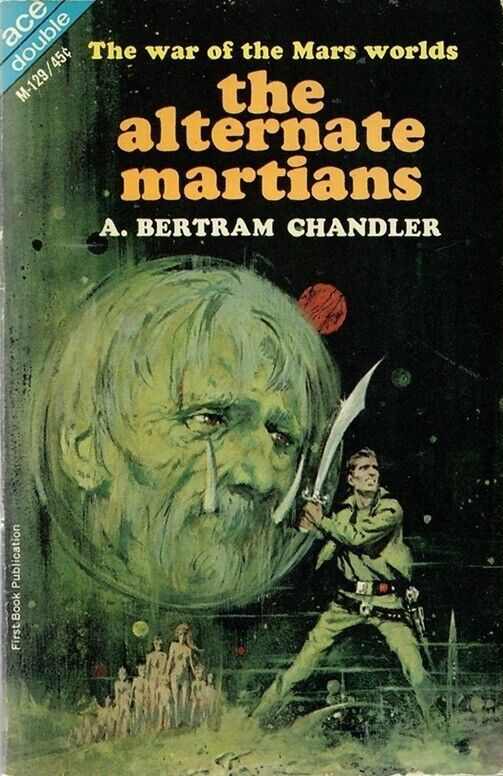
Recently Read: The Alternate Martians by A. Bertram Chandler


Here is a novel I first read as a child of ten years or so, and indeed it was the same copy. We have a 1965 Ace first edition, in poor condition (this will probably be the last time it's ever subjected to a reading, and there are better copies out there to be had). I last read it probably some decades ago, and had only a few memories to draw on, but this was the sequel to Chandler's The Coils of Time, which I reviewed in February, 2017, so it was a logical choice.

Chandler (1912-1984) was one of our favourite science fiction writers in the far-off days of childhood. Not that he was writing for children at all, some of his material was probably a bit strong for kids in retrospect, but standards were far less, well, prissy, in those days, and we got to read the books on the shelf.

Chandler was fascinated by what today we call the Multiverse concept, and explored it several times. I first heard of the notion in Science Fiction Monthly in 1974, when it was described by the old term “parallel worlds,” or “moving sideways in time,” and it would seem the latter was the concept that struck Chandler. The precept established in the previous novel was that a machine designed for time travel might, due to its own imperfectly understood nature, send a traveller sideways as surely as backward, thus accessing another stream of reality. In that event it was to a Venus where planetary catastrophe had not unfolded as it did for our Venus, giving rise to a habitable world on which a neo-Burroughsian adventure could unfold. The degree to which Chandler was devoted to the vintage science fiction of Wells and Burroughs can be gauged by the sequel, which constitutes a full-blown homage, with some original twists for good measure.

The original characters make an expedition from Science City on Venus, to Mars, taking the “Time Twister” machinery with them, with the object of trying to discover if writers like Wells and Burroughs—Leigh Bracket is also mentioned by name—were not simply creating their fantastical visions of these places, but remembering them, a kind of distorted telepathic vision transmitted across the membranes separating parallel universes (“coils of time” as Chandler called them). The intention was to send a small party through the device into this other reality to explore. However, interference from the ship's inertial drive, operated simultaneously with the time machine, sent not just the explorers through, but the entire ship...

The world in which they appear is a hostile one. Lowell's canals exist, pumped water from the high latitudes feeds cities closer to the equator, but the inhabitants of this planet are drawn from two sources—War of the Worlds (Wells's Martians, with their tripods, handling machines, heat rays and gas weapons) and the other Martians of John Carter fame, the six-limbed green ones, like Tars Tarkas. Then there are the humans, kept as slaves (and food) by the “Masters,” the tentacle-bearing, owl-eyed things that drive the tripods. These humans are the resilient Cockneys of London, scooped up by the Martians in their rampage and transported back to Mars because they were useful.

This delightful mishmash avoids being a pastiche because it paces a new spin on every aspect. Bill Carter and Delia Doris are crude but true-hearted Cockney tearaways living in rags in the Martian deserts, and Well's bacterial apocalypse for the invaders is seen to be an embellishment upon the time-spanning memory, the wishful thinking of the author—the alternative would of course have been a pessimism that made the original tale not worth telling.

The theme is revolution, the arrival of visitors from a parallel universe the catalyst for change that will rage across the planet as the oppressed humans and green Martians rise up and sweep away the stagnant, indolent overlords. Regular heroic fare, then, filled with swords and violent, brutal action—stories as they were told long ago.

Chandler's professional background as a merchant sea captain comes through very strongly. His space vessel is run on merchant marine lines, with bridge, engine room, staffing requirements—and every malady of the sea trades made manifest in space: owners versus master, liability issues, crew versus automation, civil regulations, autocratic minor functionaries throwing their weight around, a Scottish engineer who thinks he knows better than the Captain... It's rather heartwarming to see the real maritime experience of the mid-20th century perpetuated into the future—somewhat naive perhaps but it certainly spoke volumes about human optimism.

How Chandler treats women is another matter, and here he is a product of his time. There are only two main female characters, both stunningly beautiful (of course) and treated on a umber of occasions in an inherently dismissive way by narrative or dialogue. This novel was published in 1965, when women were still bound by pedantic male social custom, and to act out of the ordinary in any significant way was somewhere between risque (think Bond women, maybe?)  and unacceptable/unbelievable, so for these women to be pilots, explorers, fighters, and self-assertive, was actually quite forward-moving. For this reason, I'm prepared to forgive the broader cultural narrative of the age showing through.

The Alternate Martians was published in an Ace Doubled (M-129) back to back with Chandler's Empress of Outer Space, another great read from a great age of space opera. Can it still be found? I'm aware of at least one reissue in a new edition, and there are copies of the original to be had fairly cheaply on eBay. As with The Coils of Time, it is a work to be read in light of the age when it was written, and enjoyed as enthusiastic storytelling, with some clever twists.

Mike Adamson

Sunday, September 24, 2023

Recently Read: The War of the Worlds by H. G. Wells


Continuing with my interest in soaking up the classics, over the last few days I've had the pleasure of finally reading H. G. Wells's original 1895-97 epic, The War of the Worlds. I read a 1978 paperback copy by Golden Books of the US, still in surprisingly good condition, though the cover has been laminated with clear vinyl for durability.

Everyone knows the story, at least the high points, and it has been adapted for all conceivable media countless times—but the original remains a wonderful read and a highly worthwhile work in its own right.

It's not a long work, and the style is easily followed, if one has developed an ear for the over-formal, often over-loquacious, 19th century expression. Just as with the works of Sir Arthur Conan Doyle, one must allow, ever so slightly, for changing modes of expression over time, as indeed for the idiosyncrasies of individual style. Besides the formalities, there are figures of speech we just don't use any more, nor have we in living memory, but I find myself mentally editing, translating these expressions into the common word usage of today, so there is no jar or difficulty. On the same point, it's worth noting that Robert Louis Stevenson's style could be a lot more jarring to the modern ear than either Doyle's or Wells's, at least in Jekyll and Hyde, though not, oddly, in Treasure Island.

The War of the Worlds is the story of an English summer late in Victorian times, when a profound change came over the world. London and its immediate counties was the venue for the arrival of alien invaders, a desperately overused theme in science fiction in general, but Wells's novel was the first time in literary history that it appeared, and one can imagine the effect it must have had upon its first readers. For contemporary society to be faced with an implacable foe whose technology was a mystery and who regarded human beings as we have been guilty of regarding all other lifeforms on our own planet, can easily be seen as a commentary on the ills of the world, the way that science fiction has often been the “safe” vehicle for social critique and discussion. There is considerable comment on this aspect out there in the literature, and indeed Wells was inspired to write his novel by aspects of British colonialism.

The narrative is a first person account through the eyes of an unnamed protagonist (which seems a little odd to us today), as well as a second-hand account from the character's brother of other events elsewhere. It would seem the Martians landed only in England (a tradition Dr Who has upheld staunchly, as surely as aliens only ever arrive in America in American works). The story is told nigh blow-by-blow and from the personal viewpoint, as a man alone struggles through catastrophe, fire and battle, and the horrors of the refugee columns fleeing the invaders. Wells was indeed quite graphic in his descriptions, more so than I had expected, though tasteful enough to sensibilities attuned to modern Hollywood's seemingly ubiquitous brutality and splatter.

The action takes place mostly between Surrey, to the west of London, and in the city itself, and I found myself most engaged when the protagonist walks through parts of London I know well—on streets I have actually visited myself. He walked up Baker Street to Regent's Park at a time we know Sherlock Holmes to have lived there, so two aspects of the fictional reality of the times intersect in a strange and very neat way.

The 19th century notions of high technology are of course quaint to us, but it is fascinating to see what Wells was forecasting with his Martians. Walking machines—we've done them, if not tripodially; the “heat ray” preguesses the laser beam by sixty years; the “black smoke” is a terrible foreshadowing of chemical weapons as used only twenty years later; and the “handling machine” with which the Martians construct new systems after landing can be easily visualised by us as it would seem to be a large robot, equipped with handling arms, styled more or less on a scorpion.

Wells has a wonderful turn of phrase. His descriptions of the English countryside, his character sketches, and his oratory describing scenes of disaster and conflict resonate off the page over 126 years later, and make his era come very much alive. Likewise, he was clearly an astute student of human nature, for in this work he finds the best and worst among his fellow beings.

The novel was perhaps controversial in its time for its depiction of religion as both the cornerstone and crutch of society, yet also a thing of words in the mouths of those of insufficient moral strength to face the situation. The character known only as “the curate” is the epitome of this—a man of God who is a profound coward, who loses his mind so thoroughly that he must finally be “silenced” by our protagonist as they hide from the Martians. This part was transposed (sanitised) in the 1953 Americanised movie into the noble if misguided priest who walked out before the war machines with a cross and a Bible to exorcise them—and was vaporised.

Perhaps the device of Earthly bacteria being the downfall of the Martian organisms is too simplistic for us—surely germ theory would long predate the ability to travel between worlds—but Wells explains it in terms of the course of an alien evolution, that bacteria and viral bodies did not exist on Mars, thus were not foreseen before the invaders exposed themselves to our environment. It seems a stretch to us, but flew well enough in its day.

The entire novel can be plotted on maps. It takes place in the world of the time, and those places still exist. One could perform a tour throughout the locations, from the village of Woking where the first Martian projectile landed, through to Primrose Hill in London, where the last war machines came to a halt as their pilots died. It would be quite an adventure to recreate the events of that long-ago summer.

If you're a fan of Sherlock Holmes or other Victorian to Edwardian classics, I highly recommend Wells's The War of the Worlds. It's not much like the dark derivative filmed by the BBC a few years ago, and no US production has anything in common beyond a name and a concept. (The US has always updated and set the story locally, from Orson Welles's famous (infamous?) Mercury Theatre radio production of 1938, to Spielberg's highly derivative movie of 2005, and others.) To read the original is to put yourself into a world long gone, yet tackle notions which were at that time wholly fresh and profoundly disturbing.

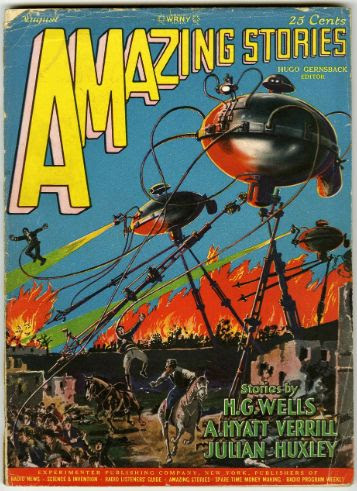
I could not locate a file of the cover of the edition I read, so instead present above the famous cover of the very first issue of Amazing Stories, from 1926, in which the novel was reprinted.


Mike Adamson

Wednesday, June 28, 2023

Progress on a Few Fronts


Just two placements this month (okay, there might be one tomorrow!), A Sherlock Holmes piece, “The Babbington Inheritance,” for A Year of Mystery 1886 (Belanger Books), plus a science fiction short/long flash, “Sunrise on Eris,” for Rhapsody of the Spheres from Third Flatiron. This latter is my twenty-first professional-rates placement.

However, during this month I have also completed a lengthy interview with Steve Southard, “Poseidon's Scribe,” which will be going live soon. This was a real opportunity as it gave me the chance to showcase all my main areas of endeavour, Sherlock Holmes writing, Tales of the Middle Stars and so much more. I'll post a link when it's open.

EDIT—It's open! Read it here!

Latest news on A Tradition of Evil is that the publishers are aiming for a July release, so before long my first novel will be on the shelves! Once again, I'll post the moment it's live at Amazon.

I've not done much composition lately, with writing effort at the moment going into the textual material for a brand new dedicated author website, coming in the not too distant future. This will feature essays, listings, purchase links, free reads, lashings of artwork and so forth.

More news as it breaks!


Mike Adamson


Tuesday, February 28, 2023

Recently Read: The Lost World


NB: This essay is about the original, not Michael Crichton's 1994 Jurassic Park sequel, for which he somehow was able to use the same title in some monumental generic cash-in. Presumably a lot of money changed hands.

Reviewing a book that's 111 years old seems like redundancy at best, but there are always new things to be said, and from my perspective it's more than interesting to read other works by the same hand that created Sherlock Holmes.

I read a copy that has been in the house for a very long time, the Pan paper back of 1977. It's in surprisingly good shape, only the spine is faded somewhat. The cover design is reproduced above. The first thing that struck me was that Conan Doyle's style is as distinctive as a fingerprint, not simply in the usage of terms and forms which are no longer found in the language, but his very way of putting words together. It's a dynamic style, to be sure, forward-moving, and the writer strikes an excellent balance between suspense and the implied knowledge of what's to come.

The Lost World was published in 1912, the same year as A Princess of Mars, and for the reader of embryonic science fiction it must have been an exciting age, with names like Doyle, Wells and Burroughs actively producing, and Verne as the Old Master of the genre. This is of course the first outing for Doyle's other larger-than-life character (created some 25 years after Sherlock Holmes), the irascible Professor George Edward Challenger, that polymath of the Herculean physique and the pompous, arrogant, overbearing and didactic nature.

Certainly this aspect of Challenger's character I felt may have been ever so slightly overstated in the first third of the book, such that one felt him rather a caricature, yet from most of the description one also cannot help seeing the mighty Brian Blessed in the role: the booming voice, the stature, the beard of Assyrian proportions—he was born for the role, yet was never cast in any production. (As close as he came was Professor “Atlantis” Atticus in Lost Secrets of Atlantis, first of the two MacGyver TV movies from the early 90s. The character was, in most ways, Challenger without the aggravation.)

Conan Doyle was clearly well-read on the scientific views of his time, including the vitriol and competition between dignified specialists, and public reaction to same. The 19th century was the age of public debate of scientific discourse, epitomised by the epic battles waged by Huxley on behalf of Darwin (see, for instance, Stephen Jay Gould's essay Knight Takes Bishop? from Natural History magazine, which can be found in his 1991 collection Bully for Brontosaurus), and Doyle gives us two such confrontations. They make for a wonderful arena in which big egos can clash, with much elegant oration in the process.

The concept, that isolated populations can exist without pressures which would change or destroy them, is entirely valid. Here, Doyle placed his survivors of the distant past into a closed ecosystem atop a towering plateau, quite inaccessible before the age of flight. It is based on the real-world Mount Roraima, in Venezuela, though magnified many times in size and placed in Brazil. The real mountain does indeed feature unique forms of life on its summit, though no dinosaurs, sadly.

The next thing that strikes the modern reader is the unfortunate schism between the frames of reference of then and now. The text is both racist and sexist by modern standards, with its frequent references to blacks and Amazonian Indians in derogatory or patronising terminology, and sometimes explicit reference to the Europoid male as the pinnacle of evolution, which is both racist and sexist on one package. There is only one female character, who appears as a motivating device in the first chapter and as an irony in the last, her behaviour a general dismissal of females in general, one might feel. Thus this dimension to the tale is something which must be placed firmly in its historical context, and left there.

This is likely also the fundamental reason that the book has never been filmed as it was written. Productions have always hit the high points, the gist of the story, but no production has ever been without female characters, whether a female member of the explorers' company, or the fur-clad cave-girl encountered on the plateau (which, as I recall, was a device of both the Irwin Allen 1960 movie, and the Canadian TV series from about twenty years ago). No such character exists in the book, indeed there are no “cave men” as such, but a tribe of Amazonian Indians who migrated onto the plateau by a secret path and made a home there, eternally at war with the “ape-men” who form the principle enemies of the book, other than nature itself.

And once more, we find an element that could not be introduced to an adaptation—the war between the humans and their savage, cruel, pre-human cousins, in which the Europeans join to exterminate the ape-men as a force and consign the survivors to slavery—as if that were the natural and correct order of things. Modern sensibilities choke first of all at the thought of largely killing-off a unique species, and then at the creation of a subjugated menial class. But in 1912 such things were viewed differently, and one can only remember this as an academic reality. New Sherlock Holmes fiction tends to be sanitised in such respects, so we can more comfortably view Victorian times trough modern eyes.

The Lost World is a classic example of what is today referred to as epistolary fiction. The lead character, Edward Malone, is a journalist, sent along on the expedition to report every foot of the way, and the text, told in Doyle's usual first person style, constitutes his account. Most of the chapters are framed as the letters Malone sends back to his editor in London, describing their adventures. This is a clever way to tell a novel and works well.

Doyle's descriptive skills don't often get a workout in his Sherlock Holmes stories on account of the need for brevity in the short format, indeed I can bring to mind only one stand-out example, from the only proper novel in the cycle, The Hound of the Baskervilles, being the pages describing the journey to Baskerville Hall. In The Lost World he has the chance to wax lyrical in his descriptions of the Amazonian jungles and waterways, and finally of the plateau itself, which constitutes delicious world-building. A writer inevitably hears some faceless first-reader's carping complaint that “all this exposition is unnecessary, this book could be a whole chapter shorter,” as if conciseness were some goal in itself. I would rather think that beauty of language and immersion in topic were equally worthy objectives, especially when one has room to move in long-form composition.

The Lost World has been filmed on at least six occasions. The 1925 silent production was the showcase for the first real outing of stop-motion special effects by the great Willis O'Brien, mastermind behind the FX of King Kong several years later. It wowed audiences so profoundly that the film was lengthened by a few reels of soap for some reason, yet audiences had no problem sitting through that lot to get the FX sequences. The test reel of the dinosaur material was presented by Conan Doyle at a meeting of professional magicians, at which he invited them to figure out that particular magic!

The next time it was filmed, Irwin Allen did the honours, early in his career, before his TV science fiction opus of the 60s, or his disaster movies of the 70s. He gave us a highly derivative version of the story, moved up to contemporary times, lizards with rubber appendages, filmed in slow motion to appear huge, cavegirls, and, if memory serves, even a volcanic sequence at the end. Claude Rains played Challenger at the head of an all-star cast. The great Michael Rennie, of The Day the Earth Stood Still, played Lord John Roxton, the big game hunter and all-round adventurer of the piece.

1992, just before the coming of Jurassic Park and its revolutionary digital dinosaurs, saw a film production, with John Rhys-Davies as Challenger. Another film version with Patrick Bergin as Challenger appeared in 1998. I can say I know nothing at all of these productions!

The BBC made a TV production in 2001 with closer adherence to the book in many ways, including the pteradactyl brought back to London and presented to the Zoological Society at the end. They used their brilliant CGI shop to generate the dinosaurs, springing off their ground-breaking series Walking With Dinosaurs, which launched so many other productions.

The most recent production (to my knowledge) is Sir Arthur Conan Doyle's The Lost World, a three-season (1999-2002) TV version from Canada, which lodged the explorers permanently on the plateau, and introduced tribes with which they could interact, and of course female characters. Their digital dinosaurs were notably poor, though about ten episodes in they could afford a better T. rex model than the rubbery one they began with.

The story remains eternally fascinating, and one can only imagine the impact it had on the post-Edwardian world. To present living dinosaurs was a thoroughly new and catchy idea, and to do so through the lens of contemporary science, rather than some fantasy scenario, was most compelling, as witnessed by its notable and ongoing success in print. A century later the book can be enjoyed at many levels—as grand adventure in the steps of Ryder Haggard and Talbot Mundy, certainly, definitely as a window onto its times, and lastly as its own self: the pioneering vision of a brilliant writer who combined the real with the not-real in a way that made it seem possible. And that could be said to be the real goal of all speculative fiction.

Mike Adamson


Friday, January 6, 2023

A Magical Number?


“It was seven years ago, this very day, that Mr Marley left us...” Or...

Marley was dead—as dead as a two-year-old un-responded submission.”

Okay, I couldn't help the Dickensian reference, but it really has been seven years—today—since I made my first story submission in earnest. Late in 2015 I made a few experimental submissions to test fire the method, and I'd had a few unpaid placements in the previous two years which encouraged me to get serious about the game, but January 7th, 2016, is the date inscribed in my memory as the day I really launched my bid to be a writer.

Maybe seven is the charm—they used to call it a magical number in the ancient world, and with the seventh year complete I have in some ways positioned myself for success to come. This is my annual review of progress/state of play post, and 2022 has been an interesting excursion in many ways.

Here's the raw data:

In the last seven years, I have made 2849 submissions (401 in the last 365 days). I have 196 placements (14.53:1submission/acceptance ratio, up from, 15.11:1 last year, which was am improvement on 16.008:1 the year before, indicating a steady positive decrease over time, regardless of all other factors). I currently have about 70 stories out, and my record is around 105-110, though to be fair there must have been a fair few multiple submissions and dead/in limbo subs among that lot. These figures also indicate 2583 rejections, giving a rejection/acceptance ratio of 13.178, also an improvement for the third year running (down from 13.52:1 in 2021, and 14.27:1 the previous year).

During the calendar year 2022, I made 368 submissions, scoring 32 placements (even with 2017 and 2020). This is an acceptance rate of 11.5%, down from 2021's 12.375%, but still well above 2020's 7.67%. Covid isolation has gone by (indeed, the world is behaving like the pandemic is over—funny, a hundred people are dying a month from this disease in my state alone, but, horrifyingly, society has normalised that), which might account for fewer people reading. But outlets continue to fold as well, reducing market breadth, though new magazines come along as brave publishers give it a go.

Average time between acceptances in Year Seven was up from last year's 9.125 days to 11.4 days, a sign of harder times all round. I've gone through dead patches so long I would be forgiven for wondering if I would ever see an acceptance again! But in real terms it's about the same as 2020's 11.7, which was an improvement over the previous year.

Professional placements, what are they? I don't believe I've had one in the last year...

On the face of it, productivity has been somewhat low, just 33 stories this year, totalling, however, 175, 871 words, a major jump on last year's 104, 309 words (and not far behind 2020's 186, 585). There are at this time two stories unfinished, straddling the New Year period, and it must be remembered in these totals that this year I have extended into novels, with over 50, 000 words of a near future SF project committed to digits, plus an entire mystery novel of 78, 500 words completed, edited and submitted in the same period—more about this in due course. Totalled up, this is around 400, 000 words of output in the past twelve months, which I'm pretty sure is the record for me.

I have 287 stories registered at Submission Grinder, and some 420 in my personal list (this includes work on pseudonyms).

As with last year, the standout in 2022 is again my success as a writer of Sherlock Holmes. I'm continuing to write (two new stories in prep at this time), and have appeared in seven Belanger anthologies to date, with acceptances for two more, and a second placement with Sherlock Holmes Mystery Magazine. Strand Magazine actually solicited a second story from me (still waiting to hear back about it), and I was recently invited to submit to the MX Book of New Sherlock Holmes Stories anthology series, a charity collection coming out around quarterly in support of the Undershaw School, for children with learning disabilities, run out of a house that once belonged to Conan Doyle. This is a great honour, the tables of contents of these anthologies are a who's who of major talents, and I could not be happier.

My Sherlock Holmes output for 2022 was 62, 392 words, not counting the two still in prep, and I may as well reveal that the 78, 500 word novel I completed during the year is also a Holmesian excursion. I expect to have good news about that one in due course.

My total accepted word count stands at about 987, 000 words—I really wanted to pass the million mark, and the 200th acceptance before the end of 2022, but the market seems sluggish at this time. Perhaps this is to be expected, in view of the cataract of crises pouring over the world these days, from floods to wars, and disease to monolithic corruption.

In terms of period mystery, The Inspector Trevelyan Mysteries is continuing to develop, about half a dozen stories so far, plus two Sherlock Holmes crossovers (they are contemporaries). I have high hopes of an anthology at some point, and very possibly a Trevelyan novel too.

Also during 2022, I was invited to write a jacket blurb for a horror collection, Howls from the Dark Ages, published by the Horror Obsessed Writing and Literature Society, a group in Centennial, Colorado. I did a most enjoyable online Q&A with their members in August, 2021, and was invited to submit to their disaster horror anthology, Howls from the Wreckage, due out soon.

On the table with Hiraeth Books are two anthologies, a full collection of my Lucinda Crane, Vampire/Hunter stories, and a volume of three novellas of historical fantasy—more about those when things mature.

That's where I stand at the end of Year Seven, on the brink of the two hundredth acceptance and the millionth word past the post, with a novel and single-author collections in progress. I hope one year from now I'm reporting some real developments on all fronts!


Cheers, Mike Adamson


Header pic: Image by Nile from Pixabay.

Monday, December 19, 2022

A Foray Into Horror


Horror is one of those genres which melds into others with ease—it's a sense of scene, emotional content, the provocation of reactions from the beholder. One might say that all writing is those things, but which reactions you're after determines your tone. I have always felt horror was not my natural genre—science fiction and fantasy come much more easily. But by the same token I can say I'm a big fan of the Alien franchise, which, certainly the original, is pure Gothic horror formula, and of the writings of Howard, Lovecraft and Smith, which embrace horror in many of its aspects, cosmic—, body—, and so forth. So maybe horror isn't that much of a stretch.

For some while now I've been in touch with the Horror Obsessed Writing and Literature Society (HOWLS), of Centennial, Colorado. On Sunday, August 8th, 2021, I had the pleasure of communicating on a message board with their members, and for an hour answered a wide range of writing questions as fast as I could type—I answered every point, I'm glad to say! I was also asked to write a cover blurb/endorsement for their anthology Howls from the Dark Ages, a volume of historical horror, which was another new experience!

However, I was also invited to contribute a story to their forthcoming anthology Howls from the Wreckage, a collection of disaster-themed horror, and this gave me a chance to flex the horror muscle in terms of composition. It's true, I've produced a number of pieces in the past which stray into the genre. The Moth and the Candle, in Dies InfaustusGorgon's Deep in Myths, Monsters, Mutations and Fear of the Dark, in Aurealis #104, and dramatised on No Sleep Podcast, Season 14, Ep. 25 are all maritime horror with a sci-fi edge, and I have other pieces unpublished. My fantasy piece The Dreamer in the Dark in Strange Wars has as much horror as many a Howard piece, while my early sci-fi outing Petrichor, in Wordland 8: Time We left (which seems to be no longer available) and Galaxy Anthology Series #5 certainly qualifies. So it was perhaps predictable that I would approach horror from the standpoint of both science fiction and mythology, to offer context to the chills.

There are many forms of horror, but I remember an editor once describing the nature of the field from his perspective. He said “When I read horror I want to be frightened—not disgusted.” This harked to the growing trend in horror writing to wallow in body horror, be it mutilation, torture, disease, sexual perversion or whatever, which perhaps grew out of an inevitable staleness in the old tropes. You can only dwell on vampires, werewolves, mummies and so on for so long before they lose their creepy edge, if for no other reason than mere familiarity, and the chill of fear so craved by the reader must come from fresh sources. Still, the distinction between fear and disgust is a worthy one, I feel, and a line a writer should be aware of when choosing their material, and the audience they're playing to.

The fresh writer finds new takes on old tropes—the haunted house will never go out of fashion, but such a story demands a new twist, a fresh context, something which whispers to the reader in expected ways. It needs to “say something new,” though far be it from me to use that expression critically, as I understand just how few truly new ideas there are. Not that many years ago a major US writing body issued a statement that, in their opinion, there were no new stories and could not be any, which may be interpreted as an encouragement for people to lose the attitude that a story is not worth publishing unless it somehow does the impossible. But, all the same, the onus is on the writer to try. None of us want to merely regurgitate other writers' ideas, much less their storylines, (no matter how inspired by them we may be) but no few come up with stories entirely independently, only to discover, perhaps many years later, that they were not as original as they had believed. Does that make such work necessarily a poor story, though? No!

Be that as it may, with horror I guess I try for the evocation that throws a particular kind of shadow over one's soul—the awe that comes from encountering the unknown, and the fear that goes hand-in-hand with it, which can then be met with courage by protagonists with whom the reader might identify. This formula can be applied to a wide range of genres, of course, so perhaps it's impure horror. I don't really know! But I'll be happy if what I produce finds resonance with a decent part of the readership.

Where might my horror writing go in future? Pure horror in a supernatural vein is always on the cards, perhaps occult detective outings (more about that in other posts), and there was an idea for a horror novel at the back of my mind a year or two back... We'll see where the market leans!


Header: Royalty free image, Stefan Keller art, from Pixabay: https://pixabay.com/photos/fantasy-spirit-nightmare-dream-2847724/