Continuing
with my interest in soaking up the classics, over the last few days
I've had the pleasure of finally reading H. G. Wells's original
1895-97 epic, The War of the Worlds. I read a 1978 paperback
copy by Golden Books of the US, still in surprisingly good condition,
though the cover has been laminated with clear vinyl for durability.
Everyone
knows the story, at least the high points, and it has been adapted
for all conceivable media countless times—but the original remains
a wonderful read and a highly worthwhile work in its own right.
It's
not a long work, and the style is easily followed, if one has
developed an ear for the over-formal, often over-loquacious, 19th
century expression. Just as with the works of Sir Arthur Conan Doyle,
one must allow, ever so slightly, for changing modes of expression
over time, as indeed for the idiosyncrasies of individual style.
Besides the formalities, there are figures of speech we just don't
use any more, nor have we in living memory, but I find myself
mentally editing, translating these expressions into the common word
usage of today, so there is no jar or difficulty. On the same point,
it's worth noting that Robert Louis Stevenson's style could be a lot
more jarring to the modern ear than either Doyle's or Wells's,
at least in Jekyll and Hyde, though not, oddly, in Treasure
Island.
The
War of the Worlds is the story of an English summer late in
Victorian times, when a profound change came over the world. London
and its immediate counties was the venue for the arrival of alien
invaders, a desperately overused theme in science fiction in general,
but Wells's novel was the first time in literary history that it
appeared, and one can imagine the effect it must have had upon its
first readers. For contemporary society to be faced with an
implacable foe whose technology was a mystery and who regarded human
beings as we have been guilty of regarding all other lifeforms on our
own planet, can easily be seen as a commentary on the ills of the
world, the way that science fiction has often been the “safe”
vehicle for social critique and discussion. There is considerable
comment on this aspect out there in the literature, and indeed Wells
was inspired to write his novel by aspects of British colonialism.
The
narrative is a first person account through the eyes of an unnamed
protagonist (which seems a little odd to us today), as well as a
second-hand account from the character's brother of other events
elsewhere. It would seem the Martians landed only in England (a
tradition Dr Who has upheld staunchly, as surely as aliens
only ever arrive in America in American works). The story is told
nigh blow-by-blow and from the personal viewpoint, as a man alone
struggles through catastrophe, fire and battle, and the horrors of
the refugee columns fleeing the invaders. Wells was indeed quite
graphic in his descriptions, more so than I had expected, though
tasteful enough to sensibilities attuned to modern Hollywood's
seemingly ubiquitous brutality and splatter.
The
action takes place mostly between Surrey, to the west of London, and
in the city itself, and I found myself most engaged when the
protagonist walks through parts of London I know well—on streets I
have actually visited myself. He walked up Baker Street to Regent's
Park at a time we know Sherlock Holmes to have lived there, so two
aspects of the fictional reality of the times intersect in a strange
and very neat way.
The
19th century notions of high technology are of course
quaint to us, but it is fascinating to see what Wells was forecasting
with his Martians. Walking machines—we've done them, if not
tripodially; the “heat ray” preguesses the laser beam by sixty
years; the “black smoke” is a terrible foreshadowing of chemical
weapons as used only twenty years later; and the “handling machine”
with which the Martians construct new systems after landing can be
easily visualised by us as it would seem to be a large robot,
equipped with handling arms, styled more or less on a scorpion.
Wells
has a wonderful turn of phrase. His descriptions of the English
countryside, his character sketches, and his oratory describing
scenes of disaster and conflict resonate off the page over 126 years
later, and make his era come very much alive. Likewise, he was
clearly an astute student of human nature, for in this work he finds
the best and worst among his fellow beings.
The
novel was perhaps controversial in its time for its depiction of
religion as both the cornerstone and crutch of society, yet also a
thing of words in the mouths of those of insufficient moral strength
to face the situation. The character known only as “the curate”
is the epitome of this—a man of God who is a profound coward, who
loses his mind so thoroughly that he must finally be “silenced”
by our protagonist as they hide from the Martians. This part was
transposed (sanitised) in the 1953 Americanised movie into the noble
if misguided priest who walked out before the war machines with a
cross and a Bible to exorcise them—and was vaporised.
Perhaps
the device of Earthly bacteria being the downfall of the Martian
organisms is too simplistic for us—surely germ theory would long
predate the ability to travel between worlds—but Wells explains it
in terms of the course of an alien evolution, that bacteria and viral
bodies did not exist on Mars, thus were not foreseen before the
invaders exposed themselves to our environment. It seems a stretch to
us, but flew well enough in its day.
The
entire novel can be plotted on maps. It takes place in the world of
the time, and those places still exist. One could perform a tour
throughout the locations, from the village of Woking where the first
Martian projectile landed, through to Primrose Hill in London, where
the last war machines came to a halt as their pilots died. It would
be quite an adventure to recreate the events of that long-ago summer.
If
you're a fan of Sherlock Holmes or other Victorian to Edwardian
classics, I highly recommend Wells's The War of the Worlds.
It's not much like the dark derivative filmed by the BBC a few years
ago, and no US production has anything in common beyond a name and a
concept. (The US has always updated and set the story locally, from
Orson Welles's famous (infamous?) Mercury Theatre radio production of
1938, to Spielberg's highly derivative movie of 2005, and others.) To
read the original is to put yourself into a world long gone, yet
tackle notions which were at that time wholly fresh and profoundly
disturbing.
I
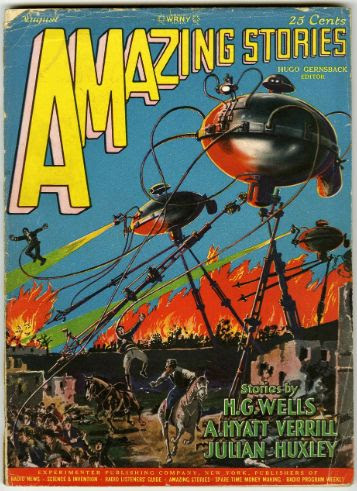
could not locate a file of the cover of the edition I read, so
instead present above the famous cover of the very first issue of
Amazing Stories, from 1926, in which the novel was reprinted.
Mike
Adamson